TIME-AWARE ROBOTIC INTELLIGENCE

The right action.
At the right time.
In the physical world, even a correct action can fail if its timing is wrong.
RoboClock demo video
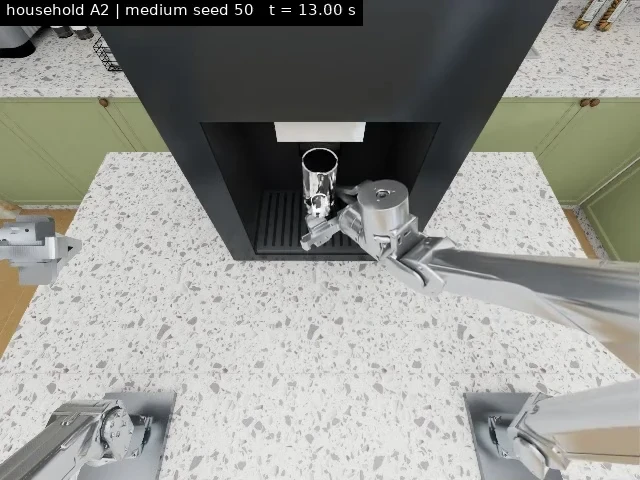
RoboClock demo videoComing soon
RoboClock Simulation Benchmark
Time-constrained manipulation across Laboratory, Healthcare, Household, Industry, and Sports & games.
Select a clip to open its task page, or browse the instructions and full demonstration videos by domain:
60Manipulation tasks
5Application domains
3Types of temporal constraints
3Difficulty levels
Three temporal constraints. One unified, latency-aligned benchmark.
Physical competence does not guarantee timely success.
TASK DESIGN
Success has a time dimension.
In the physical world, even a correct action can fail if its timing is wrong. RoboClock unifies three fundamental types of temporal constraints across 60 manipulation tasks and five application domains.
A · Temporal Window
When to act?
Act during the valid interval. Too early can be just as wrong as too late.
earlyvalid windowlate
ICE DISPENSER
Hold the glass at the dispenser, then withdraw it at the target fill level.
B · Event-Reactive
How fast to react?
Notice an external event and respond before its deadline.
eventresponse limitdeadline
MOTOR EMERGENCY STOP
Press the stop button after the fault warning appears.
C · Throughput
At what rate?
Complete enough correct units to keep pace with demand.
startsustained servicetime budget
BALL-MACHINE SERVICE
Keep the feeder stocked for repeated scheduled demand.
Three difficulty levels. Easy, Medium and Hard tighten the primary temporal constraint of each task: the window width, the response limit, or the required rate.
LATENCY-ALIGNED EVALUATION
The physical world does not pause
while a model thinks.
Existing robotic benchmarks primarily evaluate spatial correctness and task completion, often overlooking temporal requirements and inference latency. Our Latency-Aligned evaluation protocol accounts for model inference and control-interface delays: the environment evolves before each new action takes effect. Four metrics disentangle physical competence, temporal compliance, and the impact of inference latency.
AGENT
Observe
InferMeasured latency
Act
WORLD
Observation
Environment time advances
Action takes effectDuring the charged inference delay, previously committed controls remain in effect. The next action is based on an observation that is already older.
Conceptual illustration of the protocol; not a measured episode.
Progress Score
Physical competence. How far the robot gets through the physical milestones of the task.
Physical Success Rate
Physical competence. The physical goal is achieved, with temporal constraints relaxed.
Temporal Success Rate
Temporal compliance. The goal and its temporal constraints are both met, with inference paused.
Latency-Aligned TSR
Latency-aligned temporal success. TSR when inference and control-interface delays advance environment time.
THE RESULTS
RoboClock Leaderboard
All reported policy, framework and foundation-agent configurations. Explore success by temporal category and evaluation metric.
Scores in % · Select any metric heading to sort · A/B/C: 19/24/17 tasks
| Rank | Model / framework | A · Window | B · Reactive | C · Throughput | Overall | ||||||||||||
|---|---|---|---|---|---|---|---|---|---|---|---|---|---|---|---|---|---|
No matching configuration. Try another model name or comparison group.
Reported in manuscript Tables 2, 4 and 5. End-to-end policies have no PS column in the manuscript, so their PS cells are left empty and the PS columns are hidden in the VLA / WAM view. Framework rows share Qwen3.8-27B; foundation-model agents use Tool-augmented EEF. GLM-5.3 is a text-only reference. Rankings describe these configurations; training and interfaces differ across groups.
Seen versus held-out tasks · all 8 reported checkpoint configurations
Fine-tuning uses 45 tasks; 15 tasks are held out. Values reproduce manuscript Table 3.
| Model / checkpoint | Seen PSR | Seen TSR | Seen LTSR | Held-out PSR | Held-out TSR | Held-out LTSR |
|---|
FINDINGS
Can today's robots act
at the right time?
Across more than 30 evaluated methods spanning VLAs, WAMs and VLM agents, physical competence does not guarantee timely success.
8.3%
Even on Easy-level tasks, the best latency-aligned temporal success rate is only 8.3%, reached by the fine-tuned π₀.₅. The best zero-shot VLM agent, Gemini 4 Argon, reaches 8.2%.
Physical success vs. temporal success
Overall success rate (%) of four representative methods under the three success criteria.
Easy-level tasks, macro-averaged over the 60 tasks. π₀.₅ and InternW0-Δ are fine-tuned models. Manuscript Tables 2 and 5; all rows are in the leaderboard above.
FINE-TUNED VLAs
Limited generalization to unseen tasks
8.2%TSR · 45 seen tasks
2.0%TSR · 15 held-out tasks
VLAs benefit substantially from fine-tuning and keep most of their temporal success under latency, yet on the held-out tasks only X-VLA reaches a nonzero TSR.
Fine-tuned X-VLA · Table 3
WAMs
Sensitive to inference latency
10.0%TSR · inference paused
3.8%LTSR · latency-aligned
WAMs achieve the highest physical success (14.8% PSR), but most of their temporal success is lost once inference latency advances environment time.
Fine-tuned OpenWAM-α · Table 2
VLM AGENTS
Inference latency limits temporal success
19.0%Best TSR · inference paused
8.2%Best LTSR · latency-aligned
VLM agents exhibit zero-shot transfer without robot-specific training, yet inference latency reduces their temporal success from up to 19.0% to at most 8.2%.
Best of 12 VLM agents · Tool-augmented EEF · Table 5
VALIDATION · REAL-ROBOT PILOT EVALUATION
The clock keeps running
on a real arm.
Six tasks carry the three temporal categories to a UFactory xArm 6. Six VLM agents, 10 episodes per task: 360 scored episodes. There is no paused clock on hardware, so every success is latency-aligned.
96%
TASK FEASIBILITY IN SIMULATION
Human teleoperation validates that the tasks are achievable: two reviewers teleoperate every task three times under the same temporal constraints, reaching 100% PSR and 96% TSR. The real-robot pilot below extends the investigation beyond simulation.
6Real-robot tasks
6VLM agents
360Operator-scored episodes
5.1 sMedian model reply
HARDWARE
One arm, two cameras
A UFactory xArm 6 with a soft-finger gripper at a table. A RealSense D435 head camera across the table gives a 640×480 color image; a wrist camera gives an infrared image. Both are calibrated to the arm’s base frame. Unlike the simulated rig: a single arm and no depth image.
AGENT INTERFACE
Tool-augmented EEF
The single-arm version of the simulated interface: ten tools, one call per turn. A target is a base-frame point or a head-image pixel with a height above the table; tool results are measurements only. The earliest episodes (all of C2, most of A2 and B2) used direct pose commands.
SAFETY & LIMITS
Guarded execution
The arm side enforces inverse kinematics, joint and workspace limits, a table guard and a watchdog. The tool moves at 30 mm/s and an operator holds the emergency stop. An episode ends on finish, at the turn cap or 600 s, on a controller error or on operator interruption.
REAL TIME
Thinking costs time
The world does not wait for the model. The median model reply takes 5.1 s, from 3.4 s for Qwen3.8 27B to 16.8 s for DeepSeek V4.1 Flash. Time requirements are 4× the human standard time (B2: while the alarm rings).
Six tasks, three temporal categories
Select Robot view to see the first head-camera image of an episode, as the model receives it.
Results of six VLM agents
| Model | A1 | A2 | B1 | B2 | C1 | C2 | Mean | ||||||||||||||
|---|---|---|---|---|---|---|---|---|---|---|---|---|---|---|---|---|---|---|---|---|---|
| PS | PSR | LTSR | PS | PSR | LTSR | PS | PSR | LTSR | PS | PSR | LTSR | PS | PSR | LTSR | PS | PSR | LTSR | PS | PSR | LTSR | |
Scored by the operator with the step rubric on each task card. PS: mean step score; PSR: episodes that complete the task (%); LTSR: episodes that complete it within the time requirement (%; for A1, at most 100 mL poured). Each entry is the mean over 10 episodes; Mean is the unweighted mean over the six tasks. TSR is undefined on hardware. Bold: best per column.
Throughput tasks completed by any model. The best C1 progress score is 21.5.
A2 completion for Gemini 4 Argon and GPT-6 Astra, yet every completed A2 and B1 episode exceeds its time requirement.
Models with any in-time success, only on A1 and B2. Mean PS is about 54 for the leading two and 4.8–11.2 for the open-weight models.
SIMULATION VS. REAL WORLD
The model ranking transfers.
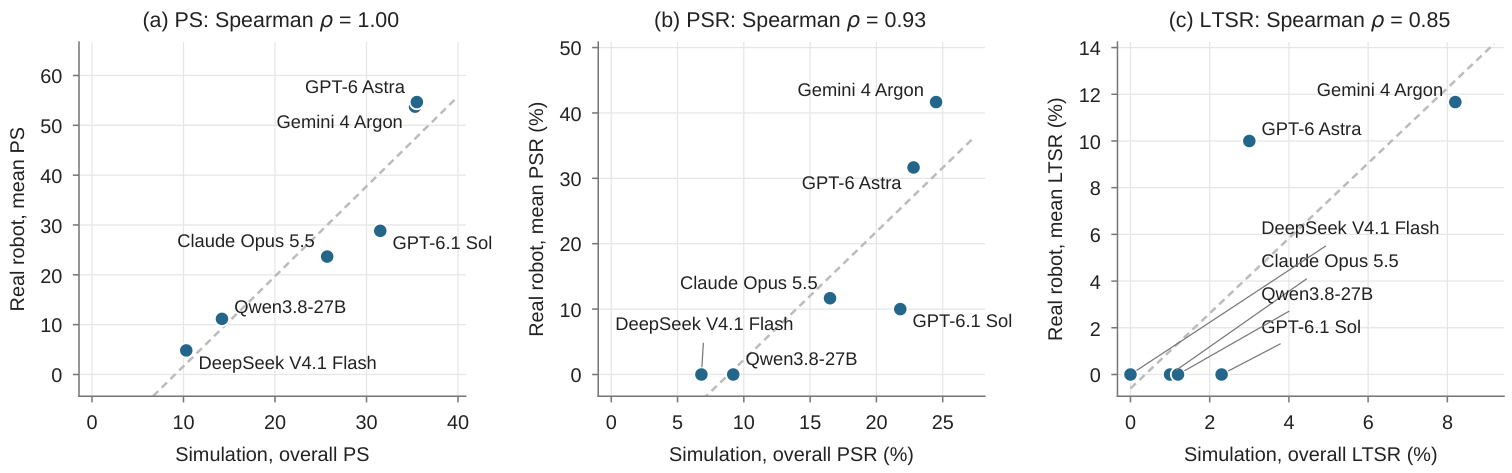
Real-robot means plotted against simulated Overall scores for the same six models (API-served models from the latest evaluation with the fastest serving; open-weight models from the main agent table). The rankings agree, with Spearman ρ = 1.00 for PS, 0.93 for PSR and 0.85 for LTSR. Gemini 4 Argon leads GPT-6 Astra in LTSR in both settings.
Absolute rates differ, so the comparison supports the ordering of models, not a mapping of success rates.
CASE STUDY · B1 LEMON ON RED
Everyone waited for red. Nobody was fast enough.
One episode per model, timed from the moment the screen turned red. Every model waited for red, but the first motion came 5.0–11.5 s later, and the three that delivered the lemon needed 45.8–78.1 s against an 8.4 s requirement. With one episode each, these runs illustrate behavior and do not rank the models.
- First motion
- Grasp
- Lemon placed
- PS
Times are seconds after the red onset, from the operator’s record. Requirement: 8.4 s. Real-time head-camera recording at 10 fps; the overlay shows wall time and the current turn.
OUR VISION
Making time a first-class dimension
of robotic intelligence.
Time-aware robotic intelligence requires jointly optimizing physical competence, temporal reasoning, and execution latency.